How to make presentations in English
 Sabrena Doherty

Giving a presentation in your own language is hard enough. Doing it in English adds a second layer of pressure: you're not just thinking about your content, you're thinking about your grammar, your pronunciation, and whether anyone can understand your accent.
The good news is that a great presentation in English isn't about sounding like a native speaker. It's about being clear, well-organised, and confident enough that your audience forgets they're listening to a non-native speaker at all.
Here's how to get there.
Preparation is everything
6a3a12d11f1a6_lg.png)
Most of the anxiety around presenting in English disappears the moment you're properly prepared. A few rules to live by:
Keep it short and simple (KISS).
Don't try to cram in every detail you know about the topic. Pick the points that matter and cut the rest.
Organise your speech using the classic formula
Say what you're going to say, say it, then say what you said. Your audience should always know where they are in your talk.
Manage your time.
As a rough guide: 10% introduction, 70% main body, 10% conclusion, 10% for questions.
Use word prompts, not a full script, if you're not using slides. And whatever you do, don't memorise word-for-word. If you memorise, you'll sound monotone, and one forgotten line can throw off the whole talk. Know your material well enough that you could explain it in your own words, in any order.
Then practise! Out loud, repeatedly, until you're sick of hearing your own voice. Practise in front of someone if you can, or record yourself and watch it back. Listen to English regularly in the lead-up to the presentation too — it tunes your ear and your mouth to the rhythm of the language.
Delivery: the public speaking side
6a3a130a3b363_lg.png)
Content aside, how you deliver a presentation matters just as much. A few things to watch for while you practise and on the day itself:
Pronunciation and pace. Speak clearly, slowly, and deliberately. Nerves make us speed up, so consciously slow down.
Avoid filler words. "Um," "ah," and overused crutches like "OK" or "for example" fill silence that would otherwise sound confident. Silence is golden — a pause is more powerful than a filler word.
Watch your tone. Monotone delivery is the fastest way to lose an audience, and it's a common trap when speaking in a second language. Stress the words that matter, pause at key moments, and listen to speakers you admire to hear how they vary their pitch.
Mind your body language. Eye contact around the room, natural hand gestures, good posture. A little goes a long way — too much movement is distracting.
Show enthusiasm. If you sound bored, your audience will be too. Smile, make eye contact, and let your energy show.
Managing Nerves
6a3a13a23bb3e_lg.png)
Nerves are normal, even for native speakers, so it helps to have a plan for them.
Take six long, deep breaths before you start to slow your breathing and calm your body.
If you forget your words mid-sentence, improvise or move on to the next point rather than freezing.
If your technology fails, smile, make a joke, and troubleshoot calmly.
If your mouth goes dry, sip water slowly.
None of these moments are disasters — they're normal, and how you handle them is part of looking professional.
Sounding professional: the phrases that hold it together
6a3a13f74cf45_lg.png)
The right linking phrases do a lot of work. They make your presentation easy to follow and instantly sound more polished, even if your vocabulary elsewhere is simple. Here are the building blocks, organised by where you'll use them.
Opening:
"Good morning/afternoon/everyone. My name is... / As you know, I'm [name], and today I'm going to talk to you about [topic]."
Then frame the structure: "In this presentation, I'll focus on three main areas" or "This talk is structured as follows..."
Mention timing ("It should take around X minutes") and let people know if they'll get materials afterwards.
Sequencing your points:
"Firstly / to begin with / first and foremost" to open a section.
"Next / moving on to our next point / our next point deals with" to transition, and "Finally / last but not least" to close it out.
These small words are what separate a presentation that flows from one that feels disjointed.
Checking the audience is following:
"Are you with me so far?", "Is everyone following so far?", "Does anyone have any questions on this part?" Dropping these in occasionally keeps your audience engaged and gives you a natural moment to slow down.
Wrapping up:
"As I mentioned earlier...", "Let's recap", "In summary / to sum up / in a nutshell", and "I'd like to finish by [verb + -ing]..." End with "That wraps up my talk on [topic]. Does anyone have any questions?"
Describing trends and figures
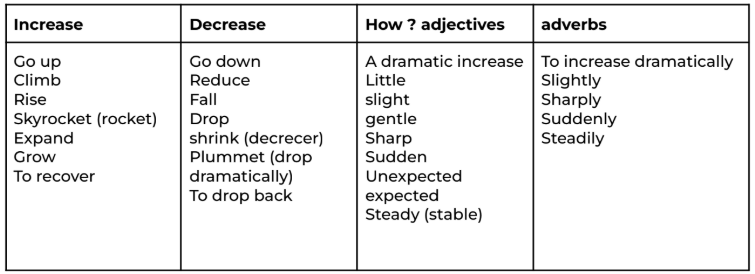
If your presentation includes data or charts, you'll also want language for describing trends. Some essentials: figures rise, climb, grow, or increase steadily/sharply/gradually; they also fall, drop, decline, or plummet.
Use "the graph shows...", "as can be seen in the chart...", or "looking at these figures, we can see that..." to introduce visuals.
Other useful verbs include peak ("sales peaked in June"), level off ("after a rise, the numbers levelled off"), fluctuate, and remain stable.
Linking words like however, although, whereas, and on the other hand help you contrast trends without sounding repetitive.
Useful verbs, adjectives and adverbs:
Handling questions with confidence
The Q&A section trips people up because it's unscripted.
A few phrases make it much easier to stay in control:
"That's a good question, I'll have to get back to you on that," "I'm not the best person to deal with that, why don't you ask...," or simply "To be honest...".
If you don't catch a question, it's completely fine to ask: "Could you say that again? I didn't catch it" or "If I understand correctly, you want to know..."
Being prepared, honest, and willing to take your time with an answer will always read as professional, regardless of your accent.
The bottom line
You don't need perfect English to give a great presentation. You need a clear structure, the right linking phrases, a delivery that doesn't sound monotone, and enough practice that nerves don't derail you. As one of our students' favourite mottos goes: know your material, and practise like hell.
Want to put this into practice?
Reading about presentation skills only gets you so far — the real progress happens when you actually stand up and do it. In our business English training, we practise presentations as part of the course, and students who want the extra challenge can give a full presentation every trimestre in front of the class. It's the fastest way to turn these phrases and techniques into habits. Join us!
📧 [email protected]
🌐 Web:Inglés con Killian
📱 WhatsApp: 622 567 969
6a3a14d13476b_lg.png)
Categories: : Business English